

Building Automation System Market
The BAS market is quietly changing its profit pools: Hardware is commoditizing while software, analytics and building intelligence capture the strategic value.
Wilmington, DE United States, Sept. 08, 2026 (GLOBE NEWSWIRE) -- Building Intelligence is Emerging as one of key Valuable Layers of Modern Real Estate
Commercial real estate is undergoing a quiet rewiring. What used to be a procurement line item managed by facilities teams has migrated into the center of asset valuation conversations, ESG disclosures, and tenant retention strategy. Owners who treated automation as discretionary capex five years ago are now negotiating against owners who treated it as a strategic asset. The gap between those two postures is widening across every major commercial corridor.
Beneath the surface of the building automation system market, a structural reordering is well underway. Energy price volatility, decarbonization mandates, and the operational economics of hybrid work have collapsed the old payback math. Buildings without intelligence are quietly being repriced. The decisions being made on platform architecture and protocol selection in the next 18 months will determine which assets remain competitive through the next leasing cycle.
Request a Free Sample Report: https://marketmindsadvisory.com/request-sample/?report_id=28
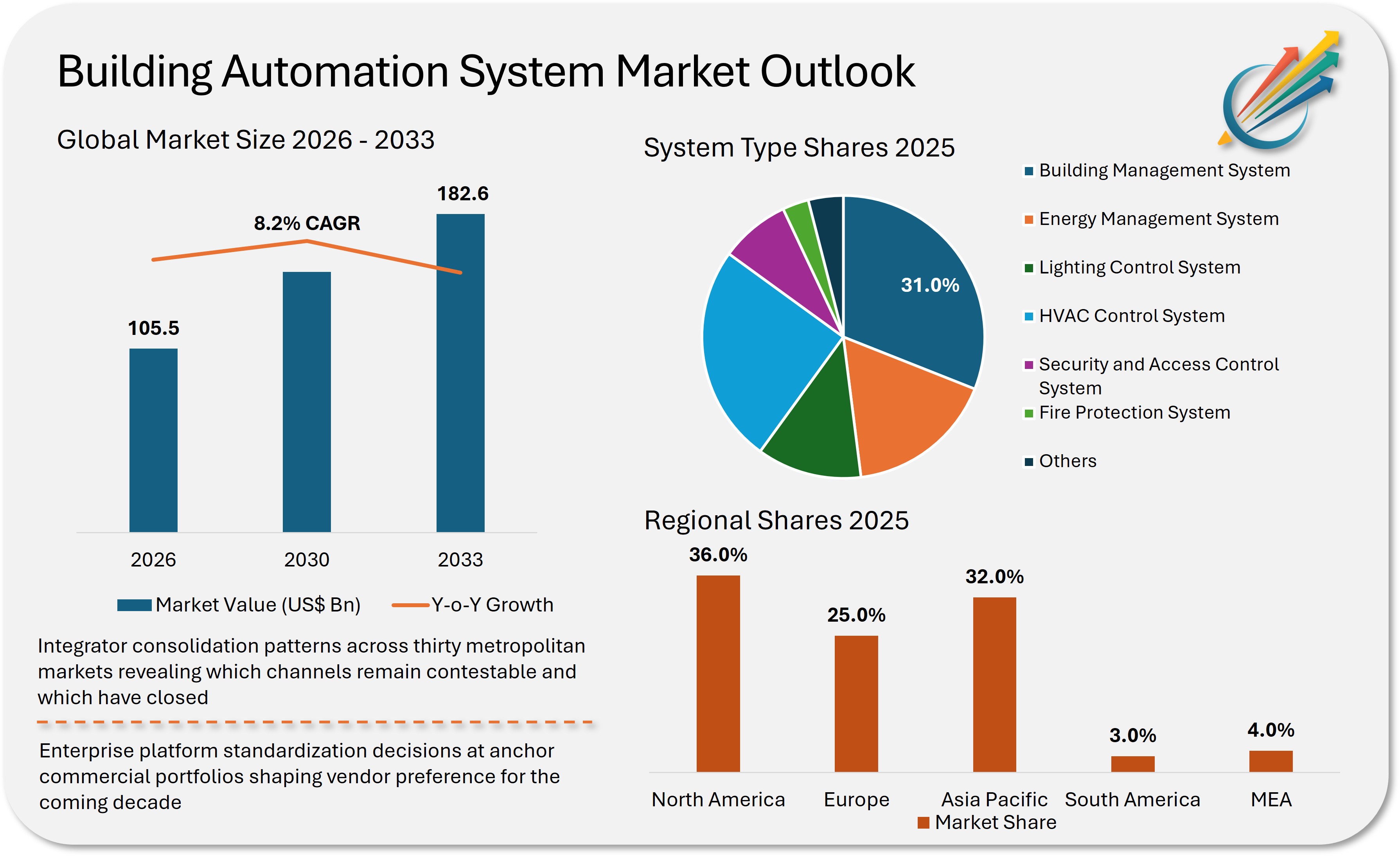
Key Takeaways from Building Automation System Market
- Global building automation system market valued at US$ 105.5 billion in 2026, anchoring a maturing capital cycle
- Projected to reach US$ 182.6 billion by 2033, expanding at a CAGR of 8.2% over the forecast period
- Commercial offices and data centers together account for the largest share of new project initiations in the building automation system market
- Cloud-based deployment models are displacing on-premise architectures in greenfield specifications
- HVAC control remains the single largest energy-related load category targeted by retrofit programs in the building automation system market
- Open protocols, particularly BACnet, are emerging as the de facto specification standard in tier-one projects
- System integrators are consolidating into multi-disciplinary platforms, reshaping the channel structure
As per Research Manager from Market Minds Advisory, " The building automation system market has crossed from being an efficiency play into being a real estate valuation lever, and a meaningful share of asset owners have not yet repriced that shift. Owners who lock in platform architecture and integrator relationships in the next four to six quarters will compound advantages that late movers cannot easily replicate."
Strategic Window why the Next Six Quarters Will Decide Platform Standardization across Commercial Portfolios
- Portfolio-level standardization is replacing building-by-building procurement: Large owners are moving from asset-specific specifications to enterprise platform commitments, which lock in vendors across hundreds of buildings simultaneously. The negotiation leverage that existed at the individual project level has effectively disappeared.
- Tenant expectations have hardened around indoor air quality and energy reporting: What used to be a differentiator is now a baseline lease requirement, and buildings that cannot supply real-time environmental and consumption data are facing measurable rent compression in tier-one markets.
-
Regulatory disclosure timelines are compressing capex decisions: Mandatory building performance standards in major jurisdictions are pulling forward retrofit programs that were previously scheduled across a longer horizon, creating a concentrated wave of system specifications.
The Center of Value Creation is Shifting away from Hardware and Toward Data Ownership
The traditional hardware-led commercial model is fragmenting. In the assessment of this research, the economic center of gravity is shifting toward analytics, supervisory layers, and recurring service revenue, and several established vendors have not yet structurally repositioned for that reality.
- Recurring revenue is reshaping vendor valuations: Cloud-hosted analytics and managed services are creating annuity-style cash flows that public markets value differently from one-time installation revenue, prompting strategic acquisitions across the building automation system market.
- Open APIs are eroding traditional lock-in: The proprietary protocols that historically protected installed bases are being displaced by interoperability requirements written into enterprise specifications, opening competitive lanes that did not exist three years ago.
-
Data ownership is becoming the binding constraint: Whoever controls the operational data layer controls the analytics roadmap, and the contractual fight over data rights is now a more important commercial question than hardware margin.
Several Structural Shifts are Challenging Long-Held Assumptions Across the Market
The retrofit opportunity will outpace new construction demand through the forecast period in mature markets. Consensus continues to emphasize greenfield commercial projects, but the installed base of underperforming buildings represents a larger near-term addressable opportunity and one that regulatory pressure is actively unlocking.
A meaningful share of independent system integrators will be absorbed into platform vendors or large mechanical contractors by 2030. The channel is consolidating quietly. The companies still operating as pure-play integrators in five years will either have scaled into regional platforms or specialized into defensible verticals.
Cybersecurity, not energy efficiency, will become the dominant procurement filter for enterprise buyers within three years. Operational technology breaches in commercial buildings have moved from theoretical to documented, and procurement teams are beginning to treat security posture as a gating criterion rather than a feature comparison.
A New Competitive Hierarchy is Forming across the Building Automation Ecosystem
Convergence of IT and OT decision authority
Operational technology procurement is moving out of facilities and into shared governance with corporate IT. The implications are commercially significant. Vendors that historically sold through mechanical channels now face buying committees that evaluate cybersecurity architecture, identity management, and cloud integration with the same rigor applied to enterprise software, fundamentally reshaping how products are specified.
Decarbonization mandates with enforceable timelines
Building performance standards in major jurisdictions have shifted from voluntary frameworks to enforceable regulations with financial penalties. Owners are responding by accelerating sensor density, sub-metering, and analytics deployment well ahead of statutory deadlines. This compresses what was a steady demand curve into a concentrated specification wave, and creates supply tightness that favors vendors with established delivery capacity.
Data center buildout as a parallel demand engine
Hyperscale and colocation construction is creating a specialized demand pool with engineering requirements that differ materially from commercial real estate. Precision cooling control, granular power monitoring, and predictive failure analytics dominate these specifications. Vendors with credentials in this segment are capturing margin profiles unavailable in conventional commercial work, and the segment continues to expand independently of broader commercial cycles.
Workforce automation in maintenance and commissioning
Skilled controls technicians remain in structural short supply across most major markets. This is pulling forward investment in remote commissioning tools, self-configuring devices, and AI-assisted fault detection. The labor constraint is reshaping product roadmaps in a way that pure feature competition has not, and vendors who solve for technician productivity are securing preferred specification status with national accounts.
Operational and Regulatory Frictions Could Slow Adoption More Than Most Forecasts Suggest
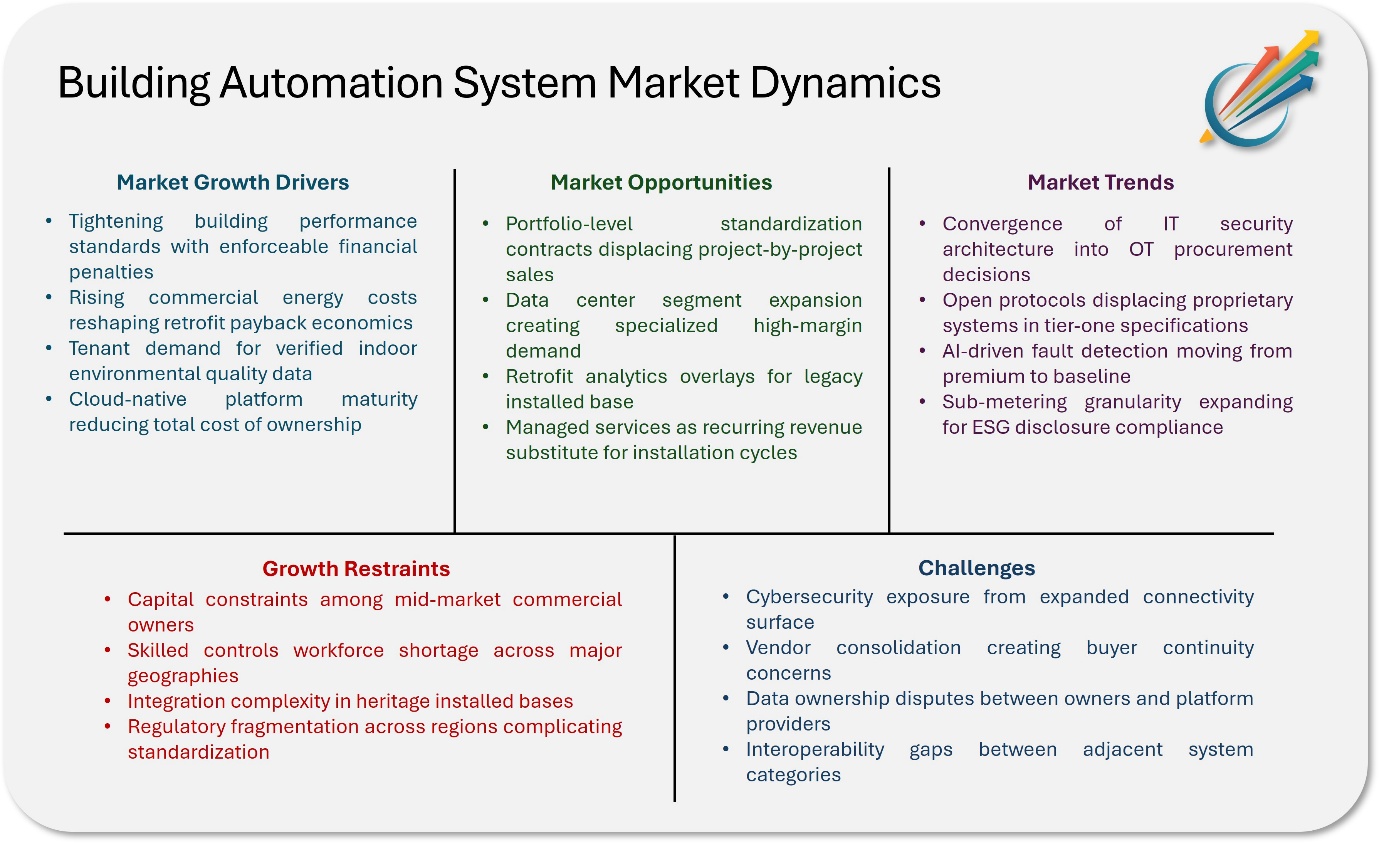
- Capital cost sensitivity: Higher interest rate environments have lengthened payback hurdle rates, particularly for mid-market commercial owners with thinner balance sheets and limited access to green financing instruments.
- Cybersecurity exposure: Connected building systems expand the attack surface, and a high-profile incident in a flagship asset could prompt insurance and regulatory responses that slow cloud deployment momentum.
- Skilled labor scarcity: Qualified controls engineers and commissioning agents are constrained across most geographies, creating execution risk for owners attempting portfolio-wide rollouts on compressed schedules.
- Interoperability friction: Legacy installed bases on proprietary protocols continue to complicate retrofits, and integration costs can absorb a disproportionate share of project budgets in older assets.
- Regulatory inconsistency: Building performance mandates vary materially by jurisdiction, complicating standardized platform decisions for owners with multi-region portfolios.
- Vendor consolidation uncertainty: Ongoing M&A activity introduces continuity risk for buyers committed to mid-tier platforms that may be absorbed or rationalized.
These headwinds are real, and any serious procurement plan accounts for them explicitly. They moderate the pace of the directional conclusion. They do not reverse it.
Market Dynamics Shaping the Building Automation System Market
Building Automation System Market Segmentation
By System Type
- Building Management System
- Energy Management System
- Lighting Control System
- HVAC Control System
- Security and Access Control System
- Fire Protection System
- Others
HVAC control and energy management together drive most of the measurable financial return in retrofit programs, which is why they dominate first-phase specifications across building automation system market. Building management systems are increasingly positioned as the integration backbone rather than a standalone category. Security and access control is converging with IT identity systems, blurring vendor boundaries. Fire protection remains structurally separated by regulation but is being absorbed into common supervisory layers.
By Component Type
- Hardware
- Sensors
- Controllers
- Actuators
- Meters
- Control Panels
- Others
- Software
- Supervisory Software
- Analytics and Reporting Software
- Cloud Platforms
- Services
- Installation and Commissioning
- Maintenance and Support
- Consulting and System Integration
The software and services share of total project value is expanding while hardware margins continue to compress in building automation system market. Sensors and meters are the volume layer, but analytics platforms capture the durable economic value. Consulting and system integration services have emerged as the highest-margin component category, particularly for portfolio-level engagements. Recurring maintenance contracts are increasingly bundled with cloud platform subscriptions.
By Deployment Type
- On Premise
- Cloud Based
- Hybrid
Cloud-based deployment dominates new commercial specifications, while on-premise architectures persist in security-sensitive segments such as government and certain industrial facilities. Hybrid models are becoming the practical default for large portfolio owners balancing data residency requirements with analytics capability. The deployment choice now drives the long-term vendor relationship more than the initial hardware selection does across the global building automation system market.
By Communication Technology
- BACnet
- Modbus
- LonWorks
- KNX
- Zigbee
- Wi-Fi
- Proprietary Protocols
- Others
BACnet has consolidated its position as the specification default in North American and increasingly European commercial projects. KNX retains strength in European residential and high-end commercial segments. Wireless protocols including Zigbee and Wi-Fi are expanding in retrofit and lighting applications where wired pulls are uneconomical. Proprietary protocols are losing ground in enterprise specifications but persist in legacy installed bases in building automation system market.
By End Use
- Residential Buildings
- Commercial Buildings
- Transportation Infrastructure
- Offices
- Healthcare Facilities
- Retail and Shopping Malls
- Educational & Government Institutions
- Hotels and Hospitality
- Manufacturing Plants
- Data Centers
- Warehouses and Logistics Centers
Commercial offices and data centers represent the largest revenue concentrations, with healthcare and educational institutions emerging as accelerating segments due to regulatory and tenant pressure. Manufacturing plants are increasingly integrating building automation with industrial automation systems, creating a convergence opportunity in the global building automation system market. Warehouses and logistics centers, historically underpenetrated, are now scaling rapidly as e-commerce operators standardize on intelligent environmental control.
Shape this report around your priorities: https://marketmindsadvisory.com/request-customization/?report_id=28
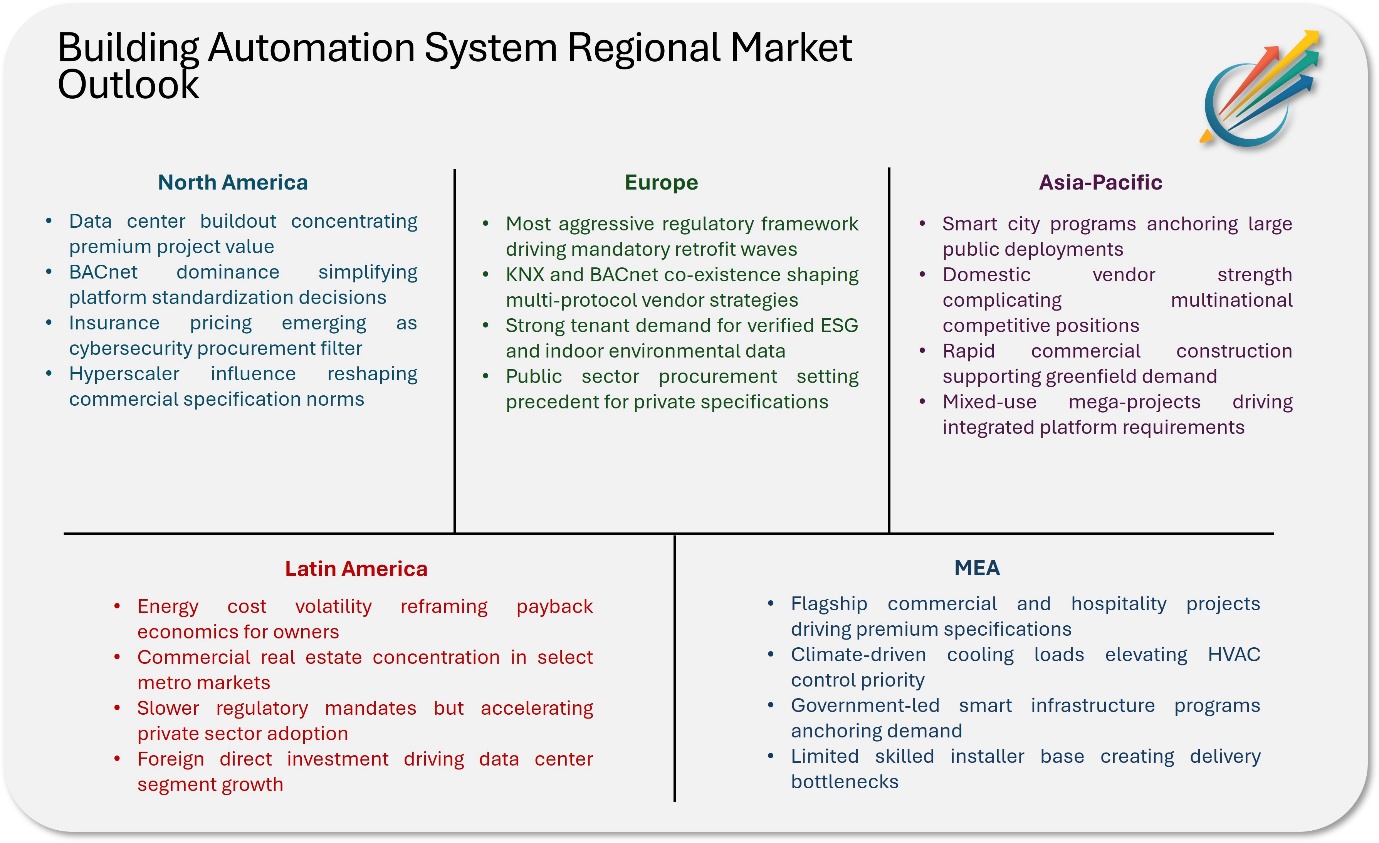
Regional Market Outlook
Investment Focus where the Prominent Opportunity is Increasing
Portfolio-level enterprise platforms
The strategic prize is no longer the individual building. It is the multi-building, multi-region platform commitment from large commercial owners. Vendors who secure these enterprise standardization decisions in the next four to six quarters will lock in revenue across thousands of assets, creating compounding advantages that late movers will not easily contest.
Analytics and managed services overlays
The installed base of buildings already running basic controls represents a larger near-term opportunity than greenfield specifications. Analytics overlays, fault detection services, and ongoing optimization contracts convert installed hardware into recurring revenue streams, and command valuation multiples that conventional installation revenue does not.
Data center and hyperscale segment
Specialized engineering requirements, urgency-driven procurement, and willingness to pay for premium performance make the data center segment the most attractive end-use vertical. Vendors with documented credentials and reference deployments are capturing margin profiles that broader commercial work cannot match, and the segment continues to expand independently of commercial cycles.
Cybersecurity-integrated offerings
As OT security becomes a gating procurement criterion rather than a feature comparison, vendors with credible security architecture, certifications, and incident response capability are differentiating decisively. This is rapidly becoming the most defensible commercial position in the building automation system market.
What This Means for Decision-Makers
Asset Owners and Operators - The building automation system market has shifted from a discretionary capex decision to a determinant of asset valuation. Owners who commit to enterprise platform standardization in the next four to six quarters will compound operational and capital advantages that late movers cannot easily replicate.
Technology Vendors - Hardware-led commercial models are losing economic relevance. The vendors structurally advantaged for the next decade are those repositioning around recurring software revenue, open architectures, and credible cybersecurity posture. Defending legacy proprietary positions is increasingly a managed decline strategy.
Investors - The investment thesis has matured past pure hardware penetration. Recurring service revenue, analytics platforms, and consolidation plays among regional integrators offer cleaner risk-return profiles than diversified incumbent exposure. The channel-level consolidation story remains underappreciated.
System Integrators - The window for independent scale is measurably narrowing. Integrators face a strategic fork between scaling into regional platforms, specializing into defensible verticals such as healthcare or data centers, or accepting absorption into larger vendors. Choosing deliberately beats being chosen.
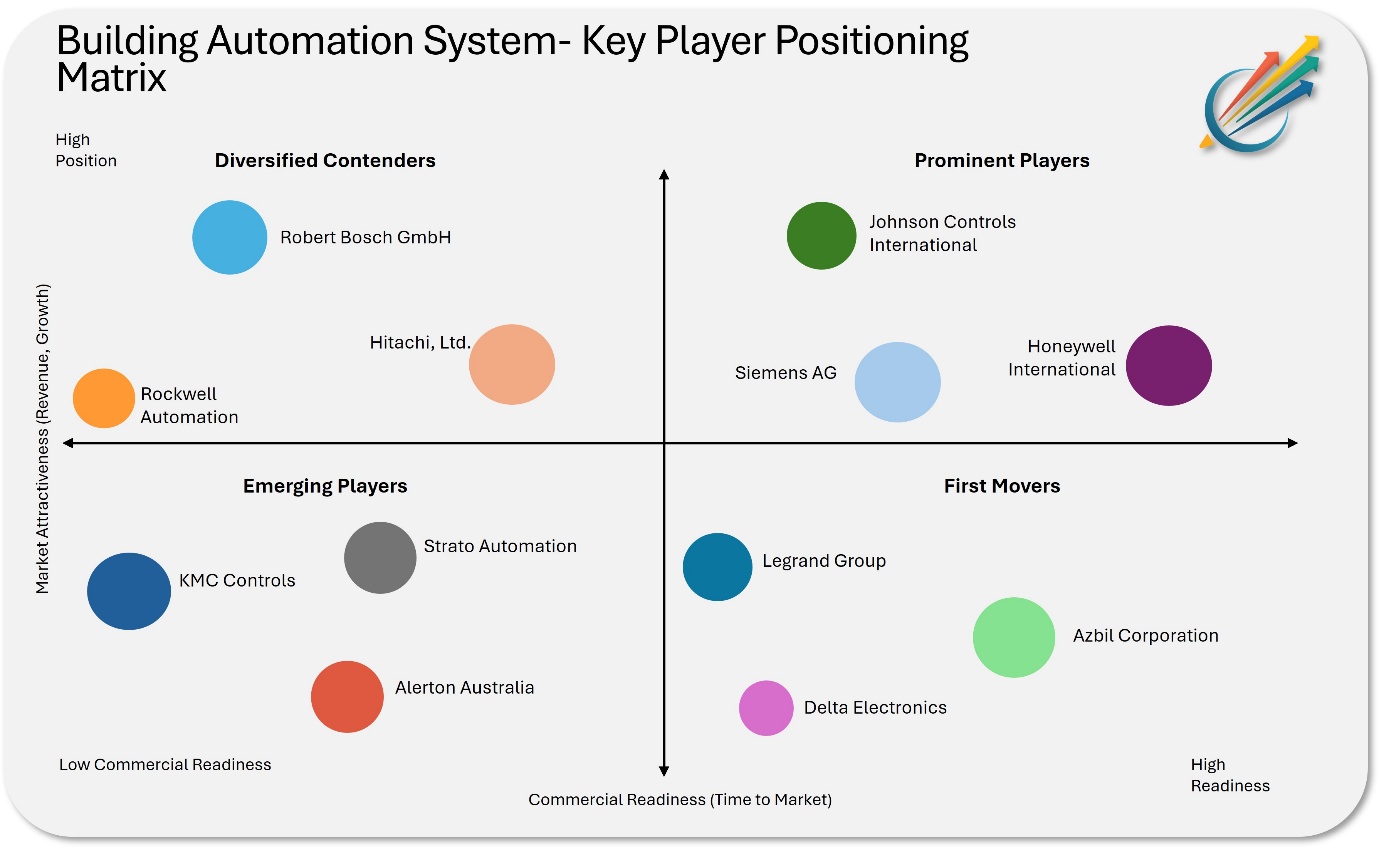
Competitive Landscape: Building Automation System Market
Recent Market Developments
- In April 2026, Johnson Controls International plc expanded its OpenBlue digital platform with enhanced analytics capabilities targeting large commercial portfolio operators.
- In February 2026, Siemens AG announced a strategic focus on accelerating its Building X cloud platform deployment across European commercial real estate accounts.
- In January 2026, Schneider Electric extended its EcoStruxure Building portfolio with new edge controllers designed for retrofit applications in legacy installed bases.
- In December 2025, Honeywell International Inc. introduced new cybersecurity-focused offerings for connected building operations addressing enterprise OT security requirements.
Market is segmented by System Type (Building Management, Energy Management, HVAC Control, Lighting Control), Component Type (Hardware, Software, Services), Deployment Type (On Premise, Cloud Based, Hybrid), and End Use (Commercial Buildings, Data Centers, Manufacturing Plants, Residential)
Get Access to complete Analysis, Buy Now: https://marketmindsadvisory.com/buy-now/?report_id=28
Trending Reports
- Energy Efficient Window and Door Market
- Industrial Energy Management System Market
- Construction Drones Market
- HVAC Control Systems Market
- Automotive Lighting Accessories Market
- LED Smart Light Pole Market
- HVAC Insulation Market
- Air Conditioning Compressor Market
- Computer Aided Facility Management (CAFM) Market
- Industrial and Workplace Safety Market
Why choose Market Minds Advisory
Market Minds Advisory delivers decision-grade intelligence to executives across machinery, packaging, chemicals, automotive, ICT, food and beverage, consumer goods, and healthcare. We help organizations sharpen market expansion strategies, accelerate share gains, refine brand positioning, and enable account-level growth. Our forecasting integrates primary interviews, proprietary demand models, and continuous market validation, producing the kind of clarity volatile and emerging industries require. Backed by over a decade of sector expertise, our research surfaces white space, opportunity gaps, and competitive blind spots, accounting for recent developments and geopolitical risk. We help businesses see the future of their markets.
Contact Us
Market Minds Advisory
1521 Concord Pike, Suite 301
Wilmington, DE 19803
United States
Email: sales@marketmindsadvisory.com
Website: https://marketmindsadvisory.com/


Legal Disclaimer:
EIN Presswire provides this news content "as is" without warranty of any kind. We do not accept any responsibility or liability for the accuracy, content, images, videos, licenses, completeness, legality, or reliability of the information contained in this article. If you have any complaints or copyright issues related to this article, kindly contact the author above.
